November 19, 2025
Understanding Credit Consumption Licenses
Snyk Credits offer customers a consumption-based license for various platform capabilities. Usage of these capabilities draws down credits from a pre-purchased balance based on the Rate Card and further described in the licensing documentation that follows.
Credits Rate Card
Capability | Credit Consumption Rate |
Snyk API & Web | 3.42 Credits per Provisioned Target per Day |
Snyk Learn | 0.66 Credits per Enrolled User per Day |
Snyk API & Web Consumption Details
Credit consumption for Snyk API & Web is based on the daily count of provisioned targets in your account. Consumption begins on the day a target is provisioned (added) and ceases the day after it is de-provisioned (removed). Any target provisioned for part of a day will consume a full day’s credits.
Each unique base URL that is defined on the Snyk platform is considered an active target (see example screenshot below). On the Snyk API & Web platform, the admin can access all currently provisioned targets from the targets section, where targets may be added and deleted.

The historical record provided by target provisioning allows teams to track issues over time, prioritize fixes on severity, and ensure compliance with security standards. Please note that the platform will discard records when the target is deleted. Discarded data is not retrievable after deletion.
Provisioned targets include access to various scan types:
Type of Scan | Definition |
Standard Scan | A comprehensive security test that attempts to cover the target application’s entire attack surface. A standard scan will map out all accessible pages accessible via a URL. |
Reduced Scope Scan | A targeted security test that focuses on a specific, smaller subset of the application’s attack surface. A reduced scope scan is limited to certain URLs, paths, or areas defined by the scan configuration. |
Incremental Scan | A type of partial scan similar to reduced scope scan. Incremental scans only scan new or updated URLs. Incremental scans require a completed standard scan as the baseline. |
Retest | A ‘microscan’ to retest a vulnerability to confirm a fix has been successfully applied. Retests scan a specific endpoint for a specific vulnerability, enabling customers to quickly check if fixes were effective. |
Snyk Learn Consumption Details
Credit consumption for Snyk Learn is based on the number of enrolled users during each day. Consumption begins on the day that a user is enrolled and stops the day after a user has been unenrolled. Users who are enrolled for part of a day consume a full day’s credit.
Enrolled users gain access to all of Learn’s capabilities, including education and training program management, and an enhanced learner experience with Snyk Assist, our AI Learning Assistant.
Feature | Included with Snyk Platform | Snyk Learn |
Product Training + Security Content | ✅ | ✅ |
Assignments | ❌ | ✅ |
Progress Reports | ❌ | ✅ |
Snyk Assist for Learn | ❌ | ✅ |
Analytics - Learn engagement, impact and training opportunities | ❌ | ✅ |
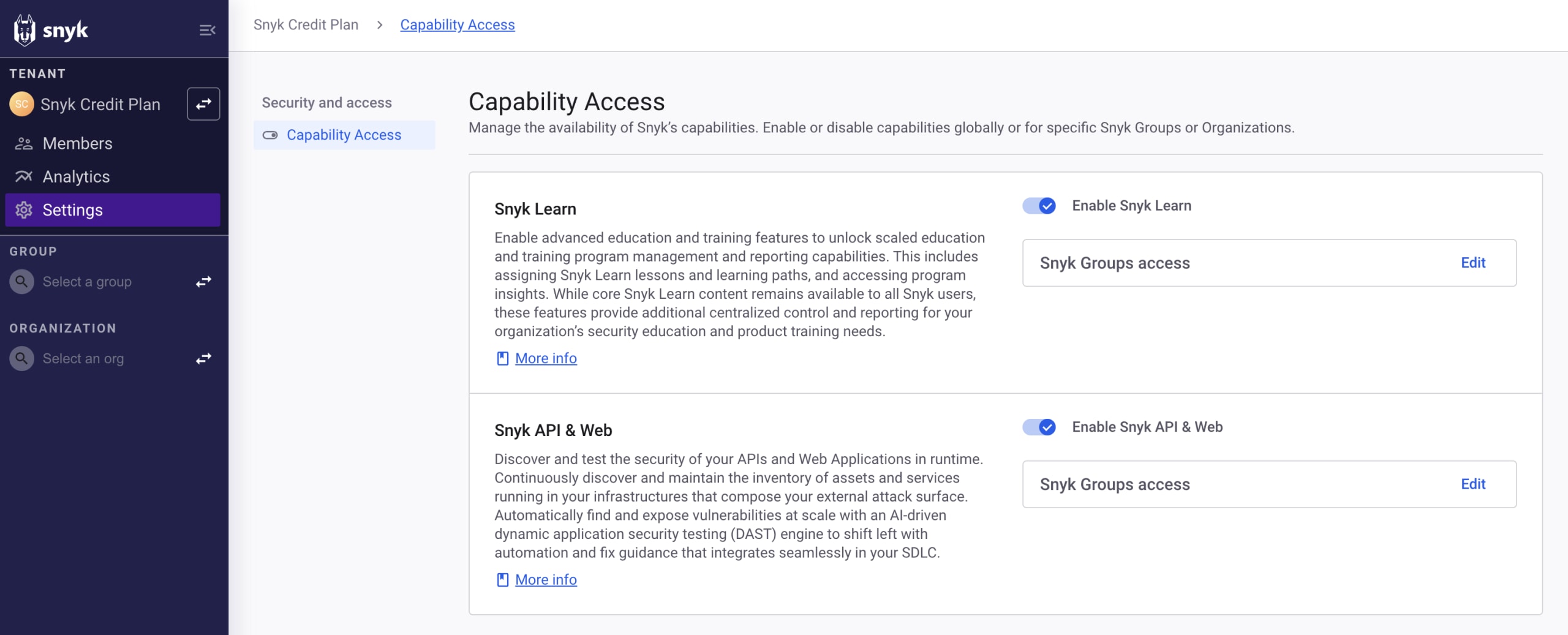
Tenant Admin users can manage enrollment using the Capability Access found in the Tenant Settings menu to define enrollment at the Organization or Group level.
Test Limits
Snyk products which are not subject to Platform Credit Consumption Licensing may be subject to test limits, as stipulated in an applicable Order and further detailed on this page.
Credit Usage Policy
Snyk Platform Credits (“Credits”) are a part of the issued subscription allocation and limited license grant to Snyk products and services. When Credits are applied, the number of Credits required to redeem services are deducted from Customer's Credit balance. Credits must be used within the term of the applicable Order, after which any unused Credits will expire and cannot be redeemed, refunded, or credited. Credits are not redeemable for cash and are non-transferable. Upon Customer's exhaustion of its Credits, Customer agrees to engage in good faith negotiations with Snyk to purchase additional credits and otherwise true-up Customer's consumption within 30 days.