Stay informed on security insights and best practices from Snyk’s leading experts.
Showing 341 - 360 of 379 articles
Infrastructure as Code in a DevSecOps World
Learn more about infrastructure as code (IaC), what it is exactly, and the security implications of using IaC in the real world.
Copyleft: The rise of open-source software licensing
Learn more about most popular copyleft licenses, terms, conditions, difference of copyleft vs copyright. Find out what’s best for your team.
Node.js licensing and security considerations
With the Node.js runtime environment becoming more popular, it's important to know about Node.js licensing and security risks for your web applications.
Application Security Testing (AST) - Top Questions Answered
Application security testing is a key step in the SSDLC. Learn more about types of application security testing, app sec testing tools, and get started with building secure apps.
Key Components of the DevOps Pipeline
A DevOps pipeline helps teams build, test, and deploy software quickly and efficiently through a combination of tools and practices. Learn how it works and how to apply it.
Secure coding practices every developer should know
Secure coding involves writing code in a high-level language that follows strict principles, with the goal of preventing potential vulnerabilities
Docker Security Scanning Guide
Learn more about Docker Security Scanning to help you get started scanning your container images in Docker and other registries.
Application Vulnerability: Avoiding Code Flaws and Security Risks
An application vulnerability is a system flaw or weakness in an application’s code that can be exploited by a malicious actor, potentially leading to a security breach.
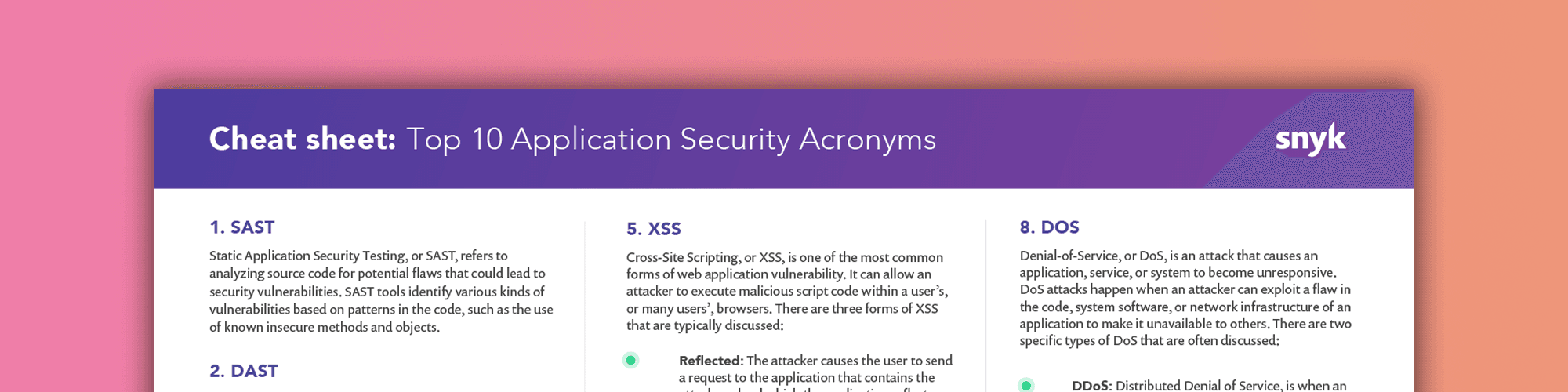
Top 10 application security acronyms
Read all about AppSec acronyms you need to know to be able to freely discuss the results of a recent penetration test or static analysis of the code.
Dynamic Application Security Testing (DAST)
Learn more about Dynamic application security testing (DAST), a type of black-box testing that checks your application from the outside while the software is actually running.
Interactive Application Security Testing (IAST)
Learn more about (IAST), application security testing method that tests your application for vulnerabilities in execution and why IAST might not even be an option for you.
Establishing Application Security Policies that Power Secure Development Processes
Learn how to establish Application Security Policies, a well-developed process that supports the speed of your organization and instills confidence in your customers
Fintech cybersecurity: How to build securely with open source
Fintech companies are attractive targets for hackers, that’s why fintech cybersecurity is so important. Learn more about how to secure your platform.
Continuous security within DevSecOps
Find out how implementing continuous security processes can benefit your DevSecOps culture and processes to help you secure your code at every phase of the SDLC
A deep dive into cyber threat intelligence
As companies continue to adopt cloud native technologies, nearly 60% have increased concerns about their security posture.
The Importance of Code Quality
Code quality is crucial for building high-quality, secure applications. Learn more about code quality, secure development, and Snyk’s code checker.
CaaS: Container as a Service Explained
CaaS (container as a service) explained and compared to alternative solutions for outsourcing your container deployments.
The Three Pillars for Implementing Secure Coding Standards
Learn more about implementing secure coding standards to deliver secure software faster than ever.
Blue-green deployment strategy explained
Learn how Blue Green Deployment strategies can be built into the IAC stages of your CI/CD Pipelines for seamless deployments with no downtime.
Application Security Controls Explained
In the security hierarchy, application security controls lie below standards and policies. Policies set the boundaries expected for application security and protection, while standards create rules for enforcing those boundaries.